This week in the BMJ
Volume 330, Number 7486, Issue of 5 Feb 2005Evidence is unfavourable for passive smoking
Evidence is unfavourable for passive smoking
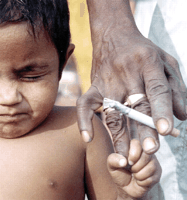
Exposure to environmental tobacco smoke is a risk factor for respiratory diseases, including cancer, in non-smokers or people who quit smoking more than 10 years ago. In a case-control study of 123 479 non-smokers nested in the multicentre EPIC cohort of 500 000 people, Vineis and colleagues (p 277) found significant correlations of cancer of the lung, pharynx, and larynx, as well as chronic obstructive pulmonary disease or emphysema, with participants' passive smoking status. McGhee and colleagues (p 287) found a dose-response relation between passive smoking and mortality from stroke, chronic obstructive pulmonary disease, lung cancer, ischaemic heart disease, and all cause mortality. Evidence is gathering that strengthens the causal link, they say.
|
![[To top]](/icons/back.gif)
Helmets protect skiers and snowboarders, but may also cause harm
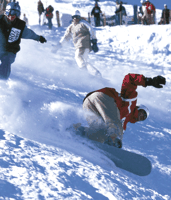
Helmets seem effective in protecting skiers from head injuries, but their role in protecting from neck injuries remains unclear. In a case-control study, Hagel and colleagues (p 281) compared estimates of matched odds ratios for the effect of helmet use on the risk of any head and neck injury, and they found that wearing a helmet reduced the risk of head injury by 29%. Results for neck injury had wide confidence intervals, so these authors could not rule out the possibility that wearing a helmet actually increases the risk of neck injury.
|
Control group is needed to assess admission avoidance schemes
As rates of hospital admission for people aged 65 years and over decline without any intervention, assessments of effectiveness of admission avoidance schemes cannot be judged by tracking admission rates without comparison with data from a control group. Roland and colleagues (p 289) analysed routine admission data from NHS hospitals in England. They found that people aged 65 and over who had at least two emergency admissions in 1997-8 made up about 38% of hospital admissions at baseline, but their percentage declined by more than 18% in the subsequent year and came down to just over 3% five years later.
|
Drug interactions may cause misdiagnosis of Cushing's syndrome
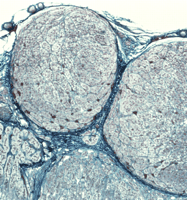
In screening patients for Cushing's syndrome, be aware of potential drug interactions with dexamethasone, as they may lead to false positive results on the screening test, the overnight 1 mg dexamethasone suppression test. Ma and colleagues (p 299) report on two patients who were investigated with a provisional diagnosis of Cushing's syndrome after they both showed failure of suppression on the test. However, both patients were taking carbamazepine at the time, one for epilepsy and the other for trigeminal neuralgia.
|
Home based medication reviews fail to improve outcomes
Home based medication reviews by pharmacists, targeted at elderly people who had had emergency admission to hospital and after discharge took at least two drugs daily, did not reduce deaths or improve patients' quality of life. Holland and colleagues (p 293) randomised 872 patients aged over 80 to two educational home visits by a pharmacist within two weeks and eight weeks of discharge or to usual practice. They found that the interventionnot only failed to reduce deaths or improve quality of life but was associated with a significantly higher rate of hospital admissions.
Would multiple submission reduce the time to publication?
Most journals do not allow authors to simultaneously submit their manuscripts to other journals. Torgerson and colleagues (p 305) propose changing this, as most manuscripts are currently sent to two or three journals before acceptance. They argue that the change of practice would perpetuate greater competition among journals and shorten publication delay. They also propose safeguards that could be put in place to avoid duplicate publication.
A new series starts: the ABC of adolescence
A series of articles on adolescence starts in this issue. The first of the 12 articles discusses biological, psychological, and social aspects of "developmental tasks," as well as psychosocial and physical development (p 302). Christie and Viner also deal with the issue of communication, providing several practical pointers for communicating and working with adolescents.
|

What's new
Keep updated


Services
Tools
Online poll
Resources
Print issues